
How to Search the Texas City Court Docket
The Texas City Municipal Court posts a link to its official portal. That portal is the right tool for any citation assigned to the city court. It accepts several search modes. Look up by citation, driver's license, or plate. Party name, Social Security number, and business name work too. Pick the least sensitive key that pulls the file. A citation number plus the required date of birth usually beats a broad name search for precision.
- Open the municipal search through the official Texas City court page.
- Select the search mode that matches the record in hand.
- Enter only the required lookup fields.
- Compare the court, citation number, violation, event, and status.
- Call or use a city form if the setting or document is missing.
Give the system time. The city forms page tells you to wait 72 hours after a citation is issued. A new case may not show up right away. The page also warns of high call volume. Lean on the portal and form links rather than the phone alone. A lookup that comes up empty does not prove no citation was filed.
Texas City Charge Sources
Where does a Class C charge come from? In Texas City, several city departments can issue one. The list includes Police, Animal Control, the Fire Marshals, and Neighborhood Improvement Services. The municipal docket also sorts source codes into groups. Examples include Alcoholic Beverage, City Ordinance, Education, Health/Safety, Penal, and Transportation. Those labels help you read a result. They are not a complete list of every possible charge.
| City source | Possible docket context | Search clue |
|---|---|---|
| Police | Traffic or fine-only penal matter | Citation number |
| Animal Control | City ordinance charge | Party or citation |
| Fire Marshals | Safety or code matter | Business or citation |
| Neighborhood Improvement | Municipal ordinance matter | Business, party, or citation |
A source category proves nothing by itself. It does not establish guilt or any outcome. Read the docket in order, through to the final entry, because a filed charge, a scheduled hearing, and a final judgment are three separate events.
The Texas City Municipal Court
You will find the court at 1004 9th Avenue N, Texas City, Texas 77590. The phone number is (409) 643-5800. Windows and phones are open Monday through Thursday, 7:30 a.m. to 5 p.m. Friday hours run 7:30 a.m. to 4:30 p.m. The court hears Class C city matters. It also hands out payment, plea, extension, insurance, and deferral forms.
Texas City Municipal Court
1004 9th Avenue N
Texas City, TX 77590
(409) 643-5800
Monday-Thursday, 7:30 a.m.-5 p.m.
Friday, 7:30 a.m.-4:30 p.m.
The official Texas City court page appears below.
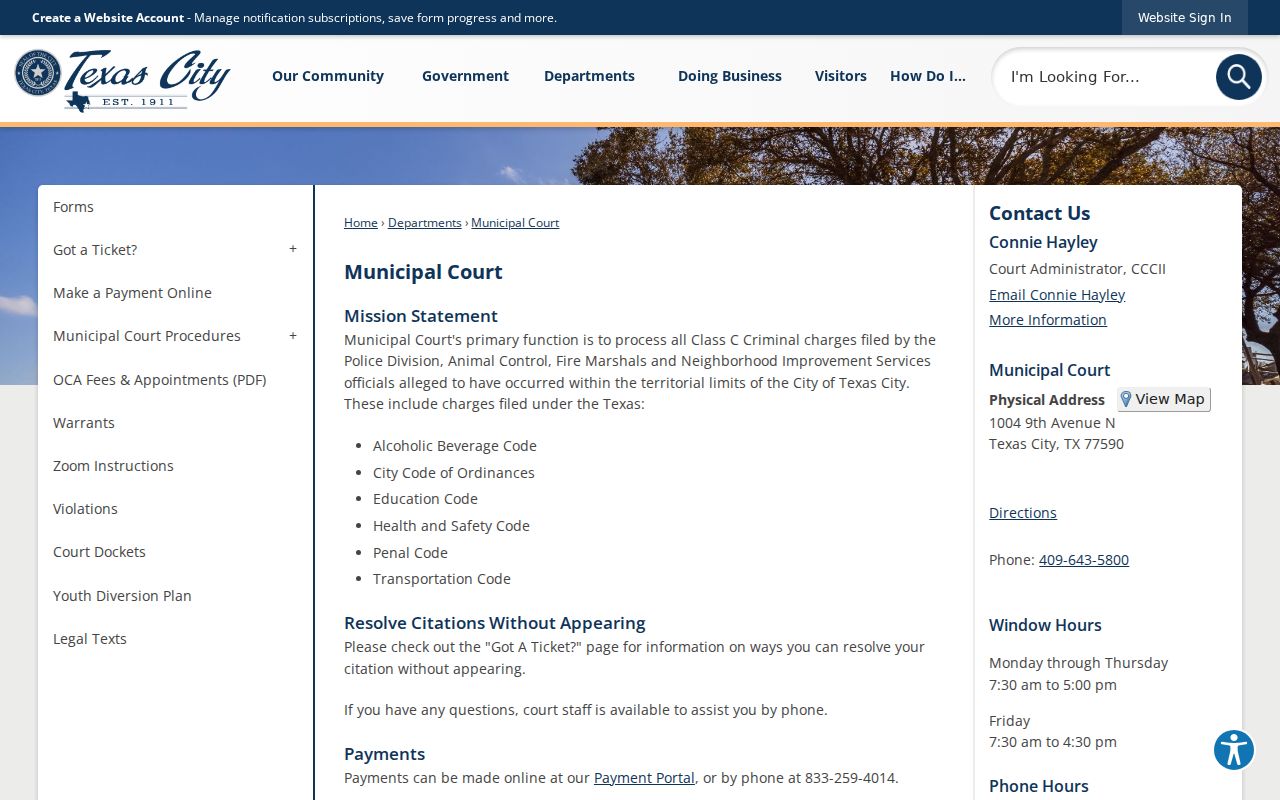
The city's own page offers a court locator plus the public contact routes. Before you drive over, check that live page again for current hours and contact details.
Texas City Portal Fields
Know your keys before you search. The portal accepts a citation number with date of birth; a license number, state, and date of birth; a Social Security number with date of birth; a plate and state; a first and last name with date of birth; or a business name. Each value is simply a key used to locate a court record. Treat them accordingly. Never publish these details or leave them sitting in a shared URL.
| Search route | When it helps | Privacy practice |
|---|---|---|
| Citation | Known city ticket | Use the exact printed number |
| Party name | No citation number | Verify the matched case |
| Plate | Vehicle-linked citation | Do not expose the result query |
| Business | Organization matter | Confirm the legal name |
If a portal row shows no image, ask the clerk for the exact docket or record product you need. A search index is not a transcript, a certified copy, or the complete file.
Texas City Court Dates and Settings
Where do Texas City court dates come from? Read the setting off the citation, the current docket, and any later court notice. The date a citation is due can differ from a hearing date. Filing a plea form may lead to a future setting. A 30-day extension changes your response arrangement under the form's terms. Don't assume it applies until the court accepts it.
| Date | The court date or response date shown in the current source. |
|---|---|
| Time | The appearance time assigned by the court. |
| Courtroom | The Texas City municipal location. |
| Judge | The judicial officer assigned to the setting. |
| Setting Type | Plea, pretrial, judge trial, jury trial, or compliance event. |
Settings move. A court date can reset. Check the next docket event instead of treating the first date as final. Note: The court's acceptance, not merely sending a form, controls the next Texas City step. When an appearance is close, contact the clerk and keep your submitted form and confirmation.
Texas City Plea and Extension Forms
The Texas City forms page is the official route, taking requests by email or mail. The plea form asks for the citation and offense. It offers a not-guilty choice. A judge or jury choice is there too. It includes a promise to appear, a signature and date, contact details, and a return email. The extension form covers a 30-day extension. It adds guilty and no-contest choices, a jury waiver, and eligibility terms. That official page shows the full forms route the city publishes.
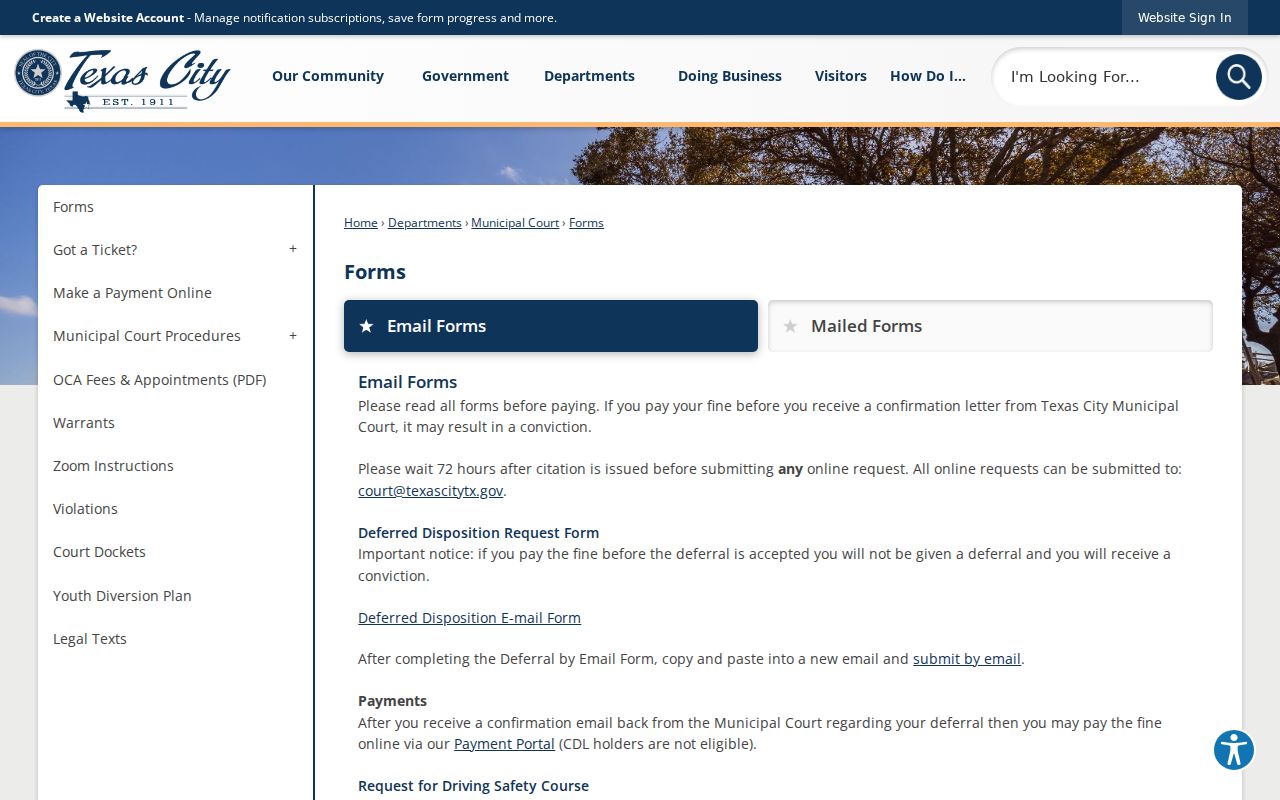
Each form makes a distinct procedural choice, so read its current terms and hold on to your confirmation. One form-specific example lists $100 down plus a $25 state fee per violation, and it states plainly that the arrangement is not a payment plan. Do not carry those amounts over to any other form.
Texas City Traffic Tickets
Paying a Texas City traffic ticket is easy. Pay online, or by phone at 833-259-4014. Paying is not the same as asking for a trial or deferred disposition, though. The forms page warns against paying before deferral confirmation. It also notes that a commercial driver's license holder may not be eligible for deferral by email. Ask the court what option currently applies rather than guessing.
Before paying: Check the plea tied to the payment and whether a pending deferral request has been approved. A payment can change the case posture.
Not every ticket belongs to this system. If yours was issued into a JP court or another municipality, the Texas City portal will not find it. Go to the issuing court named on the citation. For routing across the county, Galveston County traffic court records can point the way.
Texas City Docket Versus Transcript
The city charges $25 for an audio transcript requested before trial. That product is not a docket printout. A docket is the event index: filing, plea, setting, continuance, and result. A transcript or audio record captures what happened in the proceeding. Its timing and availability rules are separate.
| Record | What it supplies | Request route |
|---|---|---|
| Docket | Chronology and settings | Portal or clerk |
| Document copy | A filed form, order, or judgment | Specific clerk request |
| Audio transcript | Record of a proceeding, if available | Pretrial request under city terms |
Say which product you need. A request for just "the record" can slow things down, because the city may hold several record types under one citation.
Where Texas City Cases End Up
Not every Texas City case stays in Texas City. Class C tickets and ordinance violations go to the Texas City Municipal Court. A justice of the peace handles the occasional fine-only or limited civil matter. Misdemeanors filed at the county level land in the Galveston County Courts at Law. Felonies, district civil cases, and family matters sit with the District Clerk, while the County Clerk keeps probate and county court records.
Docket flow: Texas City Municipal Court › Galveston County Courts › District Court
Use the city portal only when the Municipal Court issued the ticket. Anything filed higher up belongs elsewhere. For those matters, follow the Galveston County court docket route. Pick the clerk who holds the file. An incident address inside Texas City tells you nothing by itself. It does not say which court has the case.
Texas City Missing Case Steps
Give the city its stated 72 hours after a ticket is issued. Then search again using the exact citation number. Still no match? Confirm which court did the issuing and call the Texas City clerk. A brand-new filing may simply not be indexed yet. Some cases drop out of the payment portal. They may be disposed, archived, restricted, or outside the city.
- Check the printed court and citation number.
- Use the official city link rather than a saved query URL.
- Ask for the exact setting, disposition, or document needed.
- Use the county portal only for a county or district filing.
Email the clerk sparingly. If the citation number is enough, leave other personal details out of the message. For a restricted record, ask the court whether a public docket index or a redacted copy can be released instead.
Public Access to Texas City Court Records
Court rules, statutes, common law, and court orders govern Texas court files. The Texas Public Information Act covers executive branch records. Other rules can govern a case file too. For a Texas City case, direct the request to the municipal clerk.
Key rules: The OCA Open Records Policy explains court access. Rule 12 covers judicial records, while Texas Rules 76a and 21c address civil sealing and redaction of sensitive data.
Sealed, juvenile, expunged, and sensitive files can be limited or closed off. A missing online record may also mean delay, archive status, or a different custodian. Work with the restriction, never around it.
Texas City Form Status Checks
The extension form lists a $100 down payment plus a $25 state fee per violation. Those figures belong to that form and its eligibility terms. They are not a general fee schedule for Texas City cases. Before submitting, recheck the current form. When more than one violation appears, ask the clerk how the charges stack up.
A transcript takes careful timing. The municipal court quotes a $25 audio-transcript charge only when the request is made before trial. A docket printout may come through a different process. It may contain nothing beyond event dates and labels. Say which product you want so the clerk does not have to guess.
Texas City warns of high call volume. In practice, several channels work together. The portal, forms page, email or mail instructions, phone line, and counter each play a part. Start online and keep the form confirmation. If the result shows no acceptance or next setting, contact the court directly.
The city publishes source categories that help with document requests. An Animal Control or Neighborhood Improvement Services citation may carry an ordinance label. A Police citation may fall under a transportation or penal category. Hand the clerk the printed citation number. Never translate that label into a different charge yourself.
The $25 audio-transcript figure applies to the named pretrial request context. It is not a universal price for copies. Ask for a current estimate. Say whether you want audio, a transcript, a docket printout, or a filed form.
Suppose the portal shows a balance but no event history. Use the form or phone route to ask whether a plea, extension, or disposition has posted. A dollar figure cannot reveal the full case posture. The event chronology and clerk confirmation give you that context.
Email and mail reach beyond the portal. Sending a form is only the first event, though. The clerk must still receive and process it. A plea request, extension, or deferred-disposition inquiry can each lead somewhere different. Keep your sent copy, delivery proof, and any reply. Do not pay while a deferral request waits for confirmation. The city form warns against that sequence.
After submitting, watch the Texas City docket for the next event. It might show a plea, a scheduled appearance, or another status entry. Nothing near a deadline? Call the municipal clerk. Given the high-call-volume warning, use both the web form and the phone. Do not rely on one channel.
The online plea form includes a promise to appear and, for a not-guilty plea, a judge-or-jury selection. Those fields carry procedural meaning. Read them from the current form. Treat them as steps in the process, not as promises about a date or outcome.